

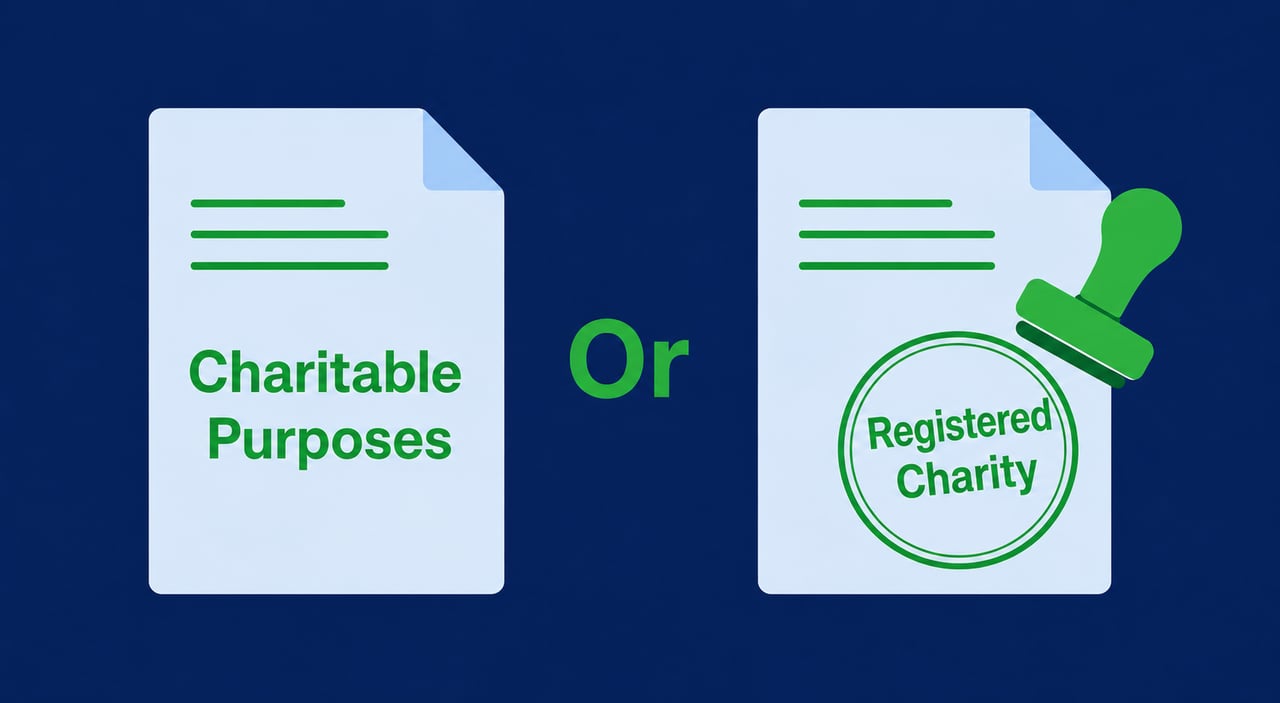
Charitable purposes and charity registration: understanding the difference
.png?width=80&name=New%20team%20member%20social%20photo%20(4).png)
One of the most common misconceptions we encounter is the assumption that if an organisation has charitable purposes, it must therefore be a registered charity.
In practice, these are different concepts. Understanding the distinction is important because it affects governance, tax treatment, public messaging, reporting obligations, and regulatory oversight.
Three concepts that are often confused
On the topic of not-for-profit and charitable organisations, there are three separate questions to consider:
1. Is the organisation not-for-profit?
A not-for-profit organisation exists to pursue its purposes rather than generate financial returns for members or owners.
Many incorporated societies, charitable trusts, and companies operate on a not-for-profit basis. Being not-for-profit does not automatically make an organisation charitable.
2. Does the organisation have charitable purposes?
An organisation may have purposes that fall within the legal concept of “charitable” because they:
-
advance education;
-
relieve poverty;
-
advance religion; or
-
provide other recognised public benefits.
An organisation can have charitable purposes without being registered as a charity with Charities Services.
3. Is the organisation a registered charity?
Registration under the Charities Act 2005 is a separate legal process.
To become a registered charity, an organisation must apply to Charities Services and satisfy the relevant legal requirements. Registration brings both benefits and obligations, including regulatory oversight and annual reporting requirements.
Why the difference matters
Not-for-profit organisations sometimes refer to themselves as a "charity" simply because they view their work as being charitable. While that may be true in a general sense, it can create confusion if the organisation is not actually a registered charity. It is also unlawful under the Charities Act 2005 for a person or organisation to claim, represent, or imply that an organisation is a registered charity when it is not.
Registered charities may benefit from certain tax exemptions, increased donor confidence, eligibility for some forms of grant funding, and the public trust often associated with charity status. They are also subject to ongoing reporting and compliance obligations.
Organisations must be careful to distinguish between having charitable purposes and being a registered charity.
What about companies?
Another common misconception is that companies cannot be charities. In fact, a company can be established with charitable purposes and operate on a not-for-profit basis.
A charitable company may choose to apply for charity registration, but the existence of charitable purposes does not automatically result in registration. Likewise, a company does not become a registered charity simply because its constitution states that it operates for charitable purposes.
What about incorporated societies?
The same principle applies to incorporated societies. While many societies have charitable purposes, others exist for different not-for-profit purposes and may not be charitable in law. A society can choose whether or not to seek charity registration if it meets the legal criteria.
Some societies pursue registration because it assists with funding opportunities, tax treatment, or public credibility. Others may decide that registration is not necessary or appropriate for their circumstances.
Charity registration can offer significant advantages, but it is not the right choice for every not-for-profit organisation.
Questions for boards and governing groups
If your organisation is considering charity registration, boards and governing groups should ask:
-
What are our purposes?
-
Are those purposes charitable in law?
-
Does our governing document support charitable status?
-
What reporting obligations will registration create?
-
Are the benefits of registration likely to outweigh the compliance costs?
-
How should we describe our organisation publicly in the meantime
Organisations must avoid assuming that having charitable purposes automatically results in charity registration or regulatory recognition.
Understanding where your organisation sits
An organisation may:
-
operate on a not-for-profit basis without having charitable purposes;
-
have charitable purposes without being a registered charity; or
-
have charitable purposes and be registered as a charity.
Understanding where your organisation sits on that spectrum helps ensure compliance, accurate public communications, and informed governance decisions.
If your organisation is unsure whether it has charitable purposes, whether charity registration is appropriate, or how its structure affects its legal obligations, obtaining advice early can prevent costly misunderstandings later.
The team at MoranLaw regularly advises charities, incorporated societies, charitable trusts, and other not-for-profit organisations on these issues. If you would like assistance assessing your organisation's position, please get in touch.