
.png?width=1280&name=Article%20Images%20(1).png)

Most trade mark disputes never make headlines. They are usually technical arguments about logos, names, and whether consumers might get confused. But the recent dispute between outdoor clothing brand Patagonia and drag queen environmentalist Pattie Gonia has broken through that norm and is currently making headlines.
So what's going on with Patagonia and Pattie Gonia?
Patagonia has filed a lawsuit alleging trade mark infringement, and what might have been a routine legal disagreement has instead become a cultural flashpoint about influence and identity and how social media may reshape the boundaries of trade mark law.
Names carry emotional weight. A brand name becomes a symbol of values, community, and identity. For individuals, especially performers, a name can be inseparable from their persona and their livelihood.
Drag performers have long used pun‑filled names as part of the art form. Courtney Act, Anita Wig’lit, and Hedda Lettuce are just a few examples. These names are playful, referential, and often parody well known brands or cultural icons.
That is where Pattie Gonia began. Created by environmental activist Wyn Wiley, Pattie Gonia is a drag persona who uses humour, camp, and outdoor imagery to promote climate action. The artist adopted the persona in 2018.
According to Patagonia, an outdoor apparel company, the relationship changed in late 2024 when Pattie began selling the following “Pattie Gonia” branded apparel and using logo variations reminiscent of Patagonia’s:
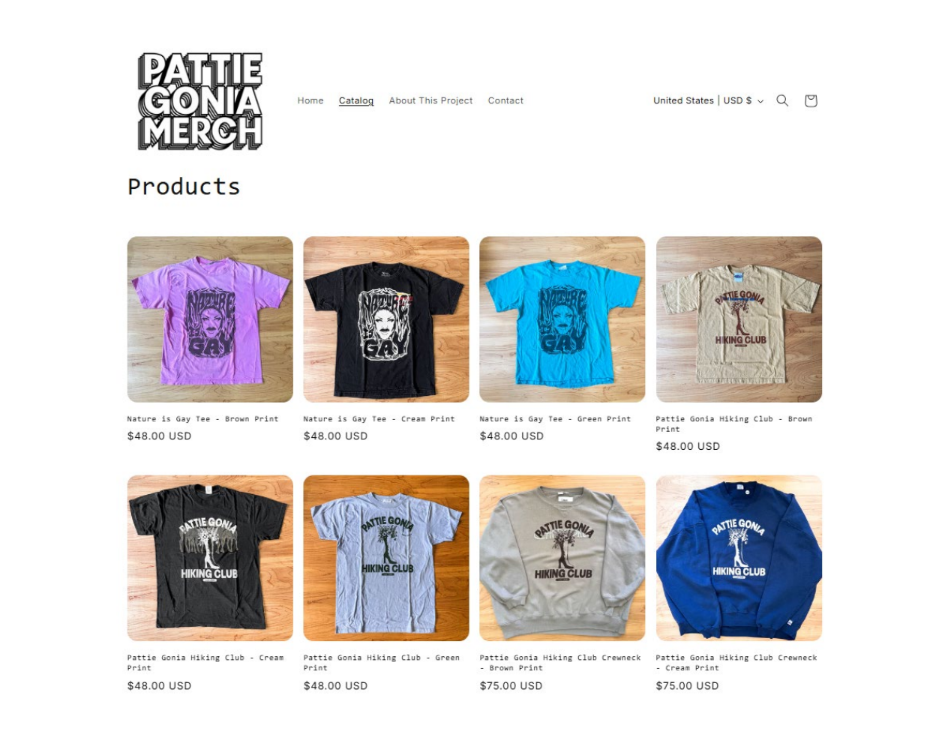
Pictured: A screenshot of pattiegoniamerch.com taken from the legal filing published in Patagonia's official press release of 21 January 2026.
In 2025, she filed a trade mark application covering clothing, activism, endorsements, and online marketing, which are areas Patagonia already operated in.
From Patagonia’s perspective, this marked a shift from parody to commercial competition. They argued that the application showed Pattie Gonia moving beyond using a persona for activism and instead intending to launch a broad commercial enterprise under the PATTIE GONIA brand. Patagonia says it had been in dialogue with Pattie for years, trying to find a way for her to continue her advocacy without infringing their rights.
A useful comparison is Trixie Mattel, whose entire persona riffs on the Barbie aesthetic. Her name nods to Mattel, her makeup exaggerates doll‑like features, and her branding plays with toy‑culture iconography. But she isn’t selling dolls or children’s products, and her merchandise doesn’t compete with or mimic Mattel’s offerings. In trade mark terms, she transforms the aesthetic without stepping into the same commercial category — which is why her drag identity hasn’t triggered the kind of conflict we’re seeing with Pattie Gonia.
Patagonia say they only sued when the commercial risk became too great, stating in a media release in January 2026 that:
“To maintain our own rights, we must prevent others from copying our brands and logos. If we do not, we risk losing the ability to defend our trademarks entirely. To put a finer point on it, we cannot selectively choose to enforce our rights based on whether we agree with a particular point of view. Inconsistent enforcement might prevent us from stopping entities like the oil and gas lobby, counterfeiters, hate groups, or other bad actors from using the Patagonia name and logo."
Pattie Gonia tells a different story. She frames the lawsuit as a powerful corporation targeting a queer climate activist for doing the very work Patagonia claims to champion. She says the case threatens her name, her community, and her livelihood. She has rallied her followers to call on Patagonia to drop the lawsuit.
As the dispute has spread across social media, it has also begun playing out in the court of public opinion. Online audiences are focusing less on the technical requirements of trade mark law and more on the broader narrative. For many observers, the legal framework feels unfair, while the perceived imbalance between a major brand and an individual creator is more persuasive. As a result, what is legally a question of distinctiveness and enforcement is being debated publicly in terms of fairness and impact.
In New Zealand, a core requirement of a trade mark is that it must be distinctive and function as a badge of origin for a particular trader’s goods or services. If a brand owner allows others to use similar marks without challenge, they risk weakening that distinctiveness. Over time, that can even support an argument that the mark has lost its ability to identify a single source.
There is also the equitable doctrine of laches, which can prevent a brand owner from enforcing its rights if it waits too long to act after learning of a conflicting use. If a company delays and the alleged infringer builds a business or reputation in the meantime, a court may find that enforcing the trade mark later would be unfairly prejudicial.
Part of what makes the Patagonia and Pattie Gonia dispute so charged is that trade marks sit at the intersection of economics and identity. Legally, a trade mark is an economic right. It protects the commercial value of a name, reputation, and customer goodwill. Unlike intellectual property rights like copyright, which arises automatically, trade marks are more intentional. They require strategy, investment, and ongoing maintenance.
For Patagonia, doing nothing risks weakening a trade mark it has spent decades building. For Pattie Gonia, doing nothing risks losing a name that has become central to her activism and her community. The hope is that, rather than letting the dispute harden into a zero‑sum fight, both sides can settle on a practical arrangement that preserves Patagonia’s legal rights while giving Pattie room to continue her work under a clearly defined space within the mark.
Whether you’re building a brand, expanding into new markets, or navigating parody, collaboration, or competition, early trade mark strategy is the best protection. Get in touch with our trade mark specialists today if you want to explore your options.